Nobody called it a "wet signature" until there was a dry one to compare it to. For most of human history, signing your name with a pen was just... signing your name. Then email happened, PDFs happened, and suddenly we needed a word to distinguish ink on paper from pixels on a screen.
Where Does the Term Come From?
The word "wet" is not a metaphor. When you press a ballpoint, rollerball, or fountain pen against paper, liquid ink transfers from the pen tip to the surface. For a brief moment, that ink is physically wet. It then absorbs into the paper fibers and dries, leaving a permanent mark.
Before the 1990s, nobody needed this distinction. A signature was a signature. But as fax machines, email, and eventually PDF documents made it possible to sign things without touching paper, the legal and business world needed vocabulary to tell the two apart. "Wet signature" emerged as the retronym — a new name for an old thing, created because the old thing suddenly had competition.
In legal contexts, "wet ink" carries a specific meaning: an original signature on an original document. Not a photocopy. Not a scan. Not a fax. The actual pen mark on the actual piece of paper. Some institutions care deeply about this distinction, which is why the term persists even in 2026.
Why Lawyers Prefer Blue Ink
Here is a piece of practical wisdom that has survived the digital revolution: if you are signing a legal document with a pen, use blue ink.
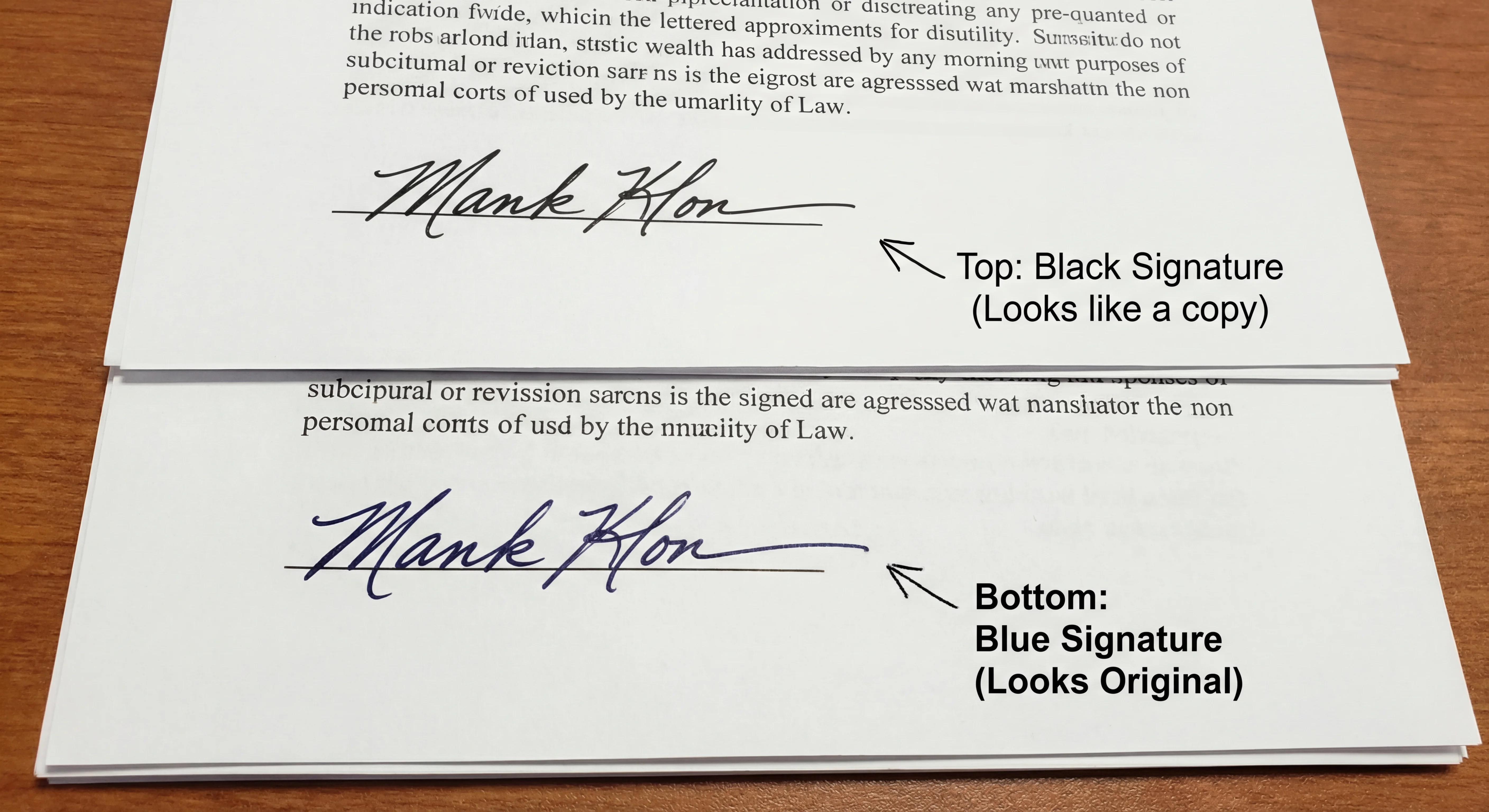
The reason is simple. Most printers and photocopiers produce black output. If you sign in black ink, a photocopy of your signature looks identical to the original. Sign in blue, and anyone can immediately tell whether they are looking at the original document or a copy. This matters in courtrooms, real estate closings, and any situation where the authenticity of the original is in question.
That said, black ink is universally accepted and perfectly fine for most business documents. The blue ink preference is a best practice, not a legal requirement.
A note on pen types
Ballpoint pens are the safest choice for legal documents. The oil-based ink dries almost instantly, resists smudging, and is extremely difficult to alter or erase. Gel pens look nicer but take longer to dry and can smear. Fountain pens are elegant but impractical for most signing situations. If you are signing something important, reach for a ballpoint.
When Is a Wet Signature Still Required?
Despite the global shift toward electronic signatures, certain documents and situations still demand pen on paper. The specifics vary by country and even by state, but here are the most common holdouts:
Wills and testaments
Almost every jurisdiction requires handwritten signatures on wills, typically witnessed by two people who also sign in ink. This is one of the most resistant areas to electronic adoption, largely because of the high stakes involved and the potential for disputes after the signer's death.
Certain real estate transactions
Property deeds, mortgage documents, and title transfers often require notarized wet signatures. This is changing — many US states now allow remote online notarization — but the transition is uneven. Always check your local requirements before assuming electronic is acceptable for a property deal.
Court filings and legal proceedings
Many courts still require original wet signatures on filings, affidavits, and sworn statements. Federal courts in the US have largely moved to electronic filing (PACER/CM/ECF), but state and local courts vary widely.
Immigration documents
USCIS forms and equivalent agencies in other countries frequently require wet ink signatures. Immigration is one of the most paper-heavy government processes remaining.
Notarized documents
Traditional notarization requires physical presence and a wet signature from both the signer and the notary. Remote online notarization (RON) is now legal in over 40 US states, but in-person notarization with wet ink remains the default in many situations.
For everything else — business contracts, NDAs, employment agreements, invoices, purchase orders, internal approvals — electronic signatures are legally valid and increasingly preferred.
Wet Signature vs Electronic Signature: A Practical Comparison
The debate is not really about which is "better." Each has strengths, and the right choice depends on the document and the situation.
| Factor | Wet Signature | Electronic Signature |
|---|---|---|
| Speed | Print, sign, scan, send | Sign and send in seconds |
| Location | Need the physical document | Sign from anywhere, any device |
| Verification | Visual comparison, forensics | Audit trail: timestamp, IP, email |
| Storage | Physical filing cabinets | Digital, searchable, backed up |
| Legal standing | Universal | Valid for most documents (some exceptions) |
| Cost | Paper, ink, postage, storage | Free or low-cost |
| Forgery resistance | Can be traced from other documents | Harder to forge with audit trail |
One thing that surprises people: electronic signatures are actually harder to forge than wet ones. A handwritten signature can be traced or copied from any document you have previously signed. An electronic signature backed by a timestamp, IP address, and email verification creates a much stronger chain of evidence.
Making the Switch: From Wet Ink to Electronic
If you have been printing, signing, scanning, and emailing documents back, you are spending time you do not need to spend. Here is the modern workflow:
- Create your signature once using Signature Sketch. Draw it with your mouse or finger for a natural handwritten look, or type your name and choose a script font.
- Download it as a transparent PNG. This is important — a transparent background means no white box covering text in your documents.
- Save the file somewhere accessible. Your desktop, cloud storage, or phone photo library all work.
- When you need to sign, insert the image into your Word document, PDF, Google Doc, or email.
You create the signature once and reuse it indefinitely. No printer, no scanner, no postage. The entire signing process takes about 10 seconds instead of 10 minutes.
And if you want your electronic signature to have that authentic blue ink look? Just select blue as your color when creating it. The result looks exactly like a wet signature — because it is based on one — but lives as a digital file you can use anywhere.
Is the Wet Signature Going Away?
Not entirely, but its territory is shrinking every year. The COVID-19 pandemic accelerated the adoption of electronic signatures by years, if not decades. Remote work made it impractical to require physical documents, and governments responded by loosening wet signature requirements across the board.
Over 40 US states now allow remote online notarization. The EU’s eIDAS regulation recognizes electronic signatures across all member states. Even traditionally paper-heavy industries like real estate and healthcare are moving toward electronic processes.
Will wills ever be signed electronically? Probably, eventually. Some jurisdictions are already experimenting with it. But for now, the wet signature retains its place for a small but important category of documents where physical presence and original ink still carry weight.
For everything else, the pen is optional.
Frequently Asked Questions
Why is it called a wet signature?
The term refers to the physical ink being wet at the moment of signing. When pen touches paper, liquid ink transfers and then dries. The word distinguishes this from electronic signatures, which exist only as digital data.
Is a wet signature more legally valid than an electronic one?
For most documents, no. The ESIGN Act and eIDAS give electronic signatures equal legal standing. Wet signatures are only required for specific exceptions like wills, certain property deeds, and some court filings.
Should I use blue or black ink?
Both are accepted. Blue ink is preferred for legal documents because it makes originals easy to distinguish from black-and-white photocopies. Black is the universal standard and works everywhere.
Can I replace wet signatures with electronic ones for business contracts?
Yes. Standard business contracts, NDAs, employment agreements, invoices, and purchase orders are all legally valid with electronic signatures in the US, EU, UK, Canada, Australia, and most other countries.